![Japanese Names - A Crash Course on Learning Japanese First and Last Names [Paperback]](http://www.thejapanshop.com/cdn/shop/files/JapaneseNamesbookcover-small_1280x.jpg?v=1699186034)
Japanese Names - A Crash Course on Learning Japanese First and Last Names [Paperback]
Thoroughly learn the top 100 family and over a hundred given names (male and female) through kanji studies, worksheets, and Anki flashcard decks.
This is the paperback version, but it also includes the eBook ePub, Anki flashcard, PDF worksheets, and MP3 sound files as a download for no extra charge. You'll receive the download link immediately after purchase and the physical paperback will mailed to you.
If you would like just the eBook version, please purchase our Japanese Culture Bundle by clicking here.
Japanese names are difficult.
Challenging kanji, atypical pronunciations, and lengthy syllable sequences can make Japanese names a hurdle for English-speaking students of the language.
If you are serious about learning Japanese, Japanese names is a subject you simply can't ignore.
Want to make Japanese friends? Having a thorough understanding of names will help. Want to enjoy Japanese movies, TV, or novels? If this fits your description, this book is for you.
And with a little concentrated study, you can learn the most common family and given names.
In this book, we'll thoroughly study the top 100 family and over a hundred given names (male and female) through kanji studies, worksheets, and Anki flashcard decks.
152 Pages
Learn the most common 100 family names today
Over a hundred given names (male and female)
Master the most common kanji and the most common readings found in Japanese names
Download Anki decks, sound files, and worksheets for no extra charge.
Imagine being introduced to Mr. Saitou. After going through this book, you ask him, "Is that a Saitou with a 斉 or a 斎?" Mr. Saitou (whether 斉藤 or 斎藤) will truly be impressed.
This book is based on a much more in-depth online course at Makoto+. If you want extra practice plus hundreds of famous names (historical, actors, actresses, musicians, singers, and more), please check out the course here:
https://makotoplus.com/makoto-courses/japanese-names-course/
It’s free for Shogun and Lifetime members.
Samurai members can find a deeply discounted coupon in the members' section. Or you can purchase the course without being a member.
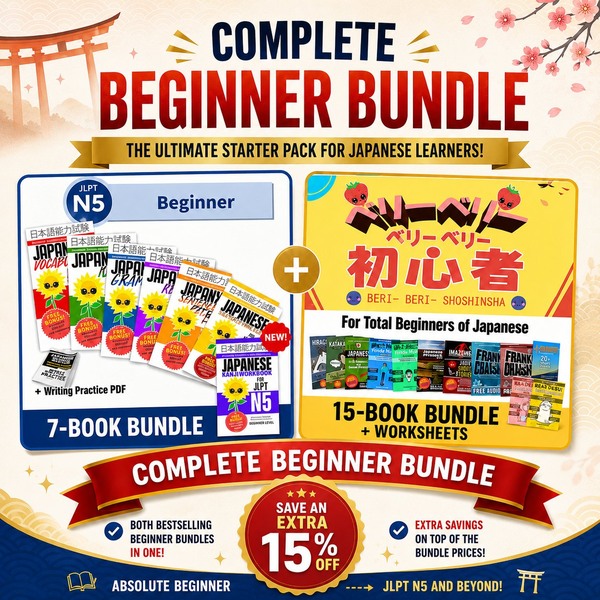
Complete Beginner Digital Bundle
Level
N5
CEFR A1 · beginner
N5
N4
N3
N2
N1
Just startingNative material
Best alongside Genki I
From Clay & Yumi, teaching Japanese since 2002. Audio recorded by Yumi and other native speakers.
Everything You Need to Go from Zero to JLPT N5 Ready
The Super Bundle
Over $125 of eBooks and Resources for $49 (USD)
Save $86 vs buying everything separately at retail.
The complete beginner path: start at zero, finish ready for the JLPT N5 exam. This Super Bundle pairs our two most popular beginner bundles into one package.
Please note: the price is $49 USD, but the system may show the price in your local currency.
Beri- Beri- Shoshinsha →
(Literally "very very beginner.") The foundation. Walks you from hiragana through basic grammar — and crucially includes our full library of beginner graded readers. Easy stories to actually practice what you learn, instead of drilling sentence patterns into a notebook and hoping they stick.
JLPT N5 →
Takes those fundamentals and sharpens them. Each book focuses on one slice of the test — grammar, vocabulary, kanji, listening, reading — so you can target weak spots before you sit. And even if you don't plan to take the JLPT, its framework is one of the cleanest ways to measure real progress at the beginner level. (A test on the calendar is a motivator that flashcards just aren't.)
About the overlap. The grammar and kanji books in each bundle cover similar ground — about 60% of the grammar topics and 80% of the kanji appear in both. But the books are built for different purposes: the Beri- Beri- versions teach the language as you'll actually use it, organized by what's useful in real life; the JLPT N5 versions teach you for the test, organized by what the exam asks and how. Same underlying material, two different angles — exactly what a serious learner wants if they care about both fluency and certification.
What Customers Are Saying
208 reviews across the two component bundles — 99% positive
★★★★★
"The printable practice sheets for Hiragana and Katakana are worth the package purchase price by themselves."
James Schmitt · Beri- Beri- Shoshinsha
★★★★★
"A great set of study materials. I really like that it includes Anki flashcards. I've been using this bundle after finishing the Genki textbook."
Anna Glaid · Batumi, GE · JLPT N5 Bundle
★★★★★
"Every sentence is broken down and explained in easy steps that helps the reader understand the structure of Japanese."
M.J. · London, GB · Beri- Beri- Shoshinsha
★★★★★
"Excellent material. I'm reviewing the kanji level 5 reading practice. I am very happy with the results. Motivated to go on."
Michael LE GRAND · Rebecq, BE · JLPT N5 Bundle
★★★★★
"The worksheets are super helpful for practicing writing and the information is easy to follow. I don't feel overwhelmed with this."
Teddy · Beri- Beri- Shoshinsha
Reviews above are from the two component bundles. The Complete Beginner Bundle is a newer SKU — its own reviews are still rolling in.
Best For
Total beginners who want both a structured curriculum AND the reading practice to make it stick
Anyone planning to sit for the JLPT N5 — or who wants a real goal to aim at
Self-studiers tired of stitching together a study plan from scattered free sources
What's Included
23+ eBooks covering hiragana, katakana, grammar, vocabulary, kanji, and reading practice
2,000+ MP3 audio files for listening and pronunciation training
Anki decks for spaced-repetition vocabulary and kanji study
Sentence Explorer integration for contextual practice (all JLPT N5 books and the Yonde Miyo~ readers in Beri- Beri- Shoshinsha)
Complete hiragana & katakana mastery materials
Structured grammar and vocabulary progression at the N5 level
Kanji and reading practice targeted at JLPT N5
Who Is This For?
This bundle is built for absolute beginners with no prior Japanese knowledge, and for pre-N5 learners who want a comprehensive, structured foundation before tackling the JLPT N5 exam.
Why Bundle?
The individual books in these two bundles would cost $135.76 at Amazon retail. Even the two standalone bundles together run $67. This Super Bundle gives you everything for $49 — the deepest discount we offer on a complete beginner curriculum, with both real-life fluency and JLPT certification covered.
All materials are delivered as digital downloads — start learning immediately after purchase.

Learn Japanese with Haiku [3 Digital Books + Audio + Anki]
Learn Japanese with Haiku is a set of three digital books that take seventy-five Japanese poems apart line by line. Every poem comes with furigana, a word-by-word vocabulary breakdown, the seasonal word that anchors it, an explanation written in simple modern Japanese, and an English essay on what the poem is actually doing. Audio for every poem and every explanation, with the new Chiyo-ni book narrated by Yumi. Three books today, ten planned, and everything we add is yours free.
Level
N4–N3
CEFR A2–B1 · upper beginner to intermediate
N5
N4
N3
N2
N1
Just startingNative material
Best after Genki I
Furigana on every kanji
Classical forms explained, not assumed
From Clay & Yumi, teaching Japanese since 2002. Every poem and every explanation is recorded, and Yumi narrates the new Chiyo-ni book herself.
New Series · Founding Price
Seventy-five poems, taken apart word by word
A haiku is seventeen syllables. That is short enough to read every single word of it and still finish in an afternoon. These three books do exactly that: the poem in Japanese with furigana, every word defined, the season word that anchors it, an explanation in simple Japanese you can actually read, and an essay in English on why the poem lands the way it does.
Upper Beginner · Intermediate (N4 to N3)
3 Books · 513 Pages
75 Haiku
150 Audio Tracks
PDF
ePub & Kobo
Anki Decks
Vocabulary Cheatsheets
Digital Extras Unlock Code
Buy now, get all ten
Three books today. Ten when the series is done. One price.
This bundle is just getting started. We are building it out to ten full haiku volumes, and everyone who buys it now gets every one of them at no extra charge, however far the price climbs between now and then.
The three books here sell for $6.99 each. The finished ten-book series will be worth several times what this bundle costs today.
The Method
What You Get for Every Single Poem
Not a translation with a footnote. Each of the seventy-five poems gets its own full chapter, six or seven pages long, built the same way every time.
The poem, with furigana
Every kanji carries its reading, plus a romaji line so you can feel the 5-7-5 rhythm before you can read at speed.
Four English translations
Not one "official" version. Four, from literal to literary, so you can see how much of a haiku lives in the choices a translator makes.
Every word defined
A bulleted vocabulary list for the poem, with furigana and bracketed notes on grammar and etymology. Nothing is left for you to guess at.
The kigo, named
The seasonal word and which season it signals. This is the machinery of haiku, and once you can spot it you read every poem differently.
An explanation in simple Japanese
The heart of the method: the poem explained in Japanese, at a level you can handle, with furigana throughout and its own vocabulary list. This is your graded reading practice.
Then an analysis in English
What the poem is doing, what the poet was living through when they wrote it, and why the word order matters. Written to be read aloud, so it works as an audiobook too.
Two recordings per poem
The haiku is read aloud, then the Japanese explanation. 150 MP3s across the three books, plus tap-to-listen links inside the PDFs. Yumi narrates the new Chiyo-ni book, and full native-speaker audio for the other two is coming very soon, free to everyone who owns the bundle.
Classical Japanese, explained
These are real poems, so they use けり, なり, 垂るる, old kana. The books teach those forms as they come up instead of pretending they are not there.
A quick-reference spread
All twenty-five poems in one place at the back of each book with short translations, for review once you have worked through them.
75
haiku, each with its own chapter
150
recordings, poem and explanation
1,267
vocabulary words, JLPT-tagged
295
Anki cards, ready to import
The Three Books
One woman who gave her life to the form, and two of Japan’s most famous novelists who wrote haiku when nobody was looking.
1Book
Chiyo-ni 千代尼 · 1703–1775
Fukuda Chiyo of Kaga, later the nun Chiyo-ni, was the rare Edo-period woman who made her name as a poet in her own right. In 1763 her domain chose her poems as the gift for a visiting Korean embassy. Twenty-five poems, including the morning-glory-and-well-bucket haiku that Japanese schoolchildren still recite, and her death poem.
月も見て 我はこの世を かしく哉
Her final poem. Kashiku was the word a woman wrote to close a letter — and she uses it to close her life.
2Book
Akutagawa Ryūnosuke 芥川龍之介 · 1892–1927
The author of "Rashōmon" and "In a Grove," the two stories behind Kurosawa's film, and the man Japan's most prestigious literary prize is named after. Shortly before his death at thirty-five he chose seventy-seven of his own haiku for a final collection, handed out to mourners at his memorial. Many of the poems here come from it.
青蛙 おのれもペンキ ぬりたてか
"Green frog — are you, too, freshly painted?"
3Book
Natsume Sōseki 夏目漱石 · 1867–1916
The author of I Am a Cat, Botchan, and Kokoro, whose face was on the 1000 yen note until recently. He studied haiku seriously under Masaoka Shiki, his lifelong friend. His novels get translated and studied everywhere; his haiku mostly do not.
ちらちらと 陽炎立ちぬ 猫の塚
Heat shimmer over the grave of the cat — the real one, buried under a cherry tree in 1908 with a marker reading 猫の墓.
4–10Books
More poets on the way 近日公開
We are building this out to ten volumes. Every new book lands in your account free, forever, no matter what the bundle costs by then.
Look Inside · Hear It Read
Here is the very first poem in the Chiyo-ni book. Listen to the haiku, then to the Japanese explanation that follows it in the book, and flip through the sample pages below.
独り寝の さめて霜夜を さとりけり
hitorine no | samete shimoya wo | satori keri
“Sleeping alone — I wake, and the frosty night enlightens me.”
Kigo: 霜夜 shimoya, a frosty night — winter. The book gives four translations of this one, then takes apart けり, the classical ending that makes the realization land.
🎧 The haiku, read by Yumi
Your browser does not support the audio element.
Every one of the 75 poems is recorded, poem and explanation both.
🎙️ The explanation, in simple Japanese
Your browser does not support the audio element.
This is the graded-reading part, and it is recorded too.
‹ Prev
Page 1 / –
Next ›
Loading sample…
Trouble viewing? Open the Chiyo-ni sample PDF in a new tab.
What’s Included
3 complete digital books — Chiyo-ni, Akutagawa Ryūnosuke, and Natsume Sōseki, 513 pages in total
PDF, ePub, and a Kobo-ready .kepub of every book
150 audio tracks — the poem and the Japanese explanation, separately, for all 75 haiku, with Yumi narrating the Chiyo-ni book
Anki flashcard decks — a poem deck for each book, plus vocabulary decks for Akutagawa (105 cards) and Sōseki (115 cards)
A vocabulary cheatsheet for every book — 1,267 words in total, each tagged with its JLPT level and the poem it came from
An unlock code in every book for your digital extras at MakotoPlus.com
Free lifetime updates. Every new haiku volume we publish, all the way to ten, at no extra cost, plus the full native-speaker re-recording of the Akutagawa and Sōseki audio, coming very soon
Buy more, save more, no coupon needed. Add two digital bundles to your cart for an automatic 5% off your entire digital order, three for 10% off, or five or more for a full 20% off everything.
Who Is This For?
If you have finished a first textbook — Genki I, or the equivalent — you can start here. The Japanese explanations sit around N4 to N3, everything carries furigana, and every word in every poem is defined on the page.
The poems themselves are classical Japanese, which is a level nobody is at, including native speakers who have not studied it. That is the point: they are taught, not assumed. A haiku is seventeen syllables, so a form that would be forbidding in a novel is perfectly manageable one poem at a time.
Already have our Japanese Culture Bundle? These are three entirely different poets from the Bashō, Buson, Issa, and Shiki books in there, in a newer and much more detailed format.
Every one of our bundles includes:
✅ Multiple formats (PDF, ePub, Kobo, MP3s, plus Anki flashcard decks)
✅ One-time payment
✅ Discounted versus buying each book separately
✅ Free lifetime updates to this bundle
✅ Instant download, no waiting
✅ Satisfaction guaranteed. If it’s too easy or too hard, tell us and we’ll swap it for a better-suited bundle or refund you.
Instant access: your download links are ready the moment you order, and you can always come back for the newest versions by logging in here with your email and any of your order numbers.
➡️ Need help opening the eBooks? Follow the steps in our eBook guide.
俳句で日本語を学ぼう! Let’s learn Japanese through haiku.
Prev
5 of 5