
Mangajin 30
PLEASE NOTE: Mangajin ceased publication in 1998. These back issues may be new or used, but they will not be pristine. A few are still in sealed bags (for mailing), but even those are unlikely to be pristine due to shelf-wear and the amount of time passed. Please consider these as learning tools to be used rather than for collecting. That being said, if condition is important to you, please contact us with specific issues and we'll send you photos of the actual items.
Mangajin was a wonderful magazine for learners of Japanese. Each issue somehow had something for every level, but we recommend them most for upper beginners.
Those interested in translation will love how Mangajin breaks down the manga it presents, explaining grammar, vocabulary, and cultural references with ease.
The cover image above is for this particular issue. The sample pages inside may or may not be from this exact issue. See below for a table of contents (retrieved from http://www.nyx.net/~cbrown/mangajin/mangajin_toc.html)
Japanese Hotels: The Inns and outs· Breakfast in America, Japanese style?
FEATURES
特集
tokushu
7
Political Cartoon
Politicians and Bureaucrats couldn't help the Japanese rice farmer this year.
10
Japanese Hotels: the Inns and Outs
From capsule hotels to love hotels to temple lodgings, Japan offers accomodations to suit every need and every budget.
22
Using Mangajin in Class
Mangajin is finding its way into a variety of classrooms in the US and Japan.
24
Results of the 1993 Babel Translation Contest
The winning entry, along with a judge's comments.
DEPARTMENTS
連載/コラム
rensai / koramu
4
Letters
The readers write.
5
Brand News
The sale of salt in Japan has been privatized and packaging has taken on a bit more flavor.
14
A Tast of Culture by Elizabeth Andoh
Some American hotels make an effort, but there is more to a Japanese-style breakfast than just fish and rice.
18
Book Review
Lois Peak's Learning to Go to School in Japan examines the transition from the indulgence of childhood at home to the constraints of school life.
28
Basic Japanese: Maitta
If you give up, if you're in a fix, if you're at a loss -- here's a word for you.
80
Vocabulary Summary
82
Mangajin · Mono
Get your holiday cheer here!
86
Classifieds
MANGA
漫画
manga
26
Calvin and Hobbes, by Bill Watterson
34
Selected Works of Ishii Hisaichi · いしいひさいち選集
36
Garcia-kun · ガルシアくん, by Takeuchi Akira
38
Sarai-kun · サライくん, by Nishimura So
40
Obatarian · オバタリアン, by Hotta Katsuhiko
42
After Zero · アフター0, by Okazaki Jiro
51
HOTEL (Part I) · by Ishinomori Shotaro

Mangajin 28
PLEASE NOTE: Mangajin ceased publication in 1998. These back issues may be new or used, but they will not be pristine. A few are still in sealed bags (for mailing), but even those are unlikely to be pristine due to shelf-wear and the amount of time passed. Please consider these as learning tools to be used rather than for collecting. That being said, if condition is important to you, please contact us with specific issues and we'll send you photos of the actual items.
Mangajin was a wonderful magazine for learners of Japanese. Each issue somehow had something for every level, but we recommend them most for upper beginners.
Those interested in translation will love how Mangajin breaks down the manga it presents, explaining grammar, vocabulary, and cultural references with ease.
The cover image above is for this particular issue. The sample pages inside may or may not be from this exact issue. See below for a table of contents (retrieved from http://www.nyx.net/~cbrown/mangajin/mangajin_toc.html)
Japan's yen to vend:Vending Machines· Rising Sun,the movie· 自動販売機(じどうはんばいき)
FEATURES
特集
tokushu
7
Political Cartoon
A political earthquake strikes Nagata-cho.
8
The Vending Machine Phenomenon
Why are there so many vending machines in Japan? We examine the phenomenon and show examples of some of the more exotic machines.
22
The Overseas Public Relations Division
The Japanese government moves beyond the Kabuki and tea ceremony in communicating Japan to the outside world.
24
Rising Sun: the movie
Not a bad movie, but not quite like the book.
DEPARTMENTS
連載/コラム
rensai / koramu
4
Letters The readers write.
5
Announcements & Events Japan-America happenings calendar.
14
A Tast of Culture: Elizabeth Andoh The seasons are important, even at mealtime.
18
Book Reviews Japan Tracel Bureau's pocket guides; Komikku Nichi-Bei Masatsu ("Comic Japan-US Friction"), Japanese Business Etiquette, and Made in Japan.
28
Computer Corner Four Japanese word processing options for PCs--all under $100!
34
Basic Japanese: Abunai!
The word means "dangerous," but the usage in Japanese covers more ground.
88
Vocabulary Summary
90
Mangajin · Mono More stuff for study and fun.
94
Classifieds
MANGA
漫画
manga
31
The Far Side, by Gary Larson
32
Calvin and Hobbes, by Bill Watterson
40
Furiten-kun · フリテンくん, by Ueda Masashi
44
Tanaka-kun · 田中くん, by Tanaka Hiroshi
46
Beranmei Tochan · べらんめい父ちゃん, by Tachibanaya Kikutaro
48
Katsu-Shika Q · 葛飾Q, by Tomisawa Chinatsu
65
Kacho Shima Kosaku · 課長島耕作, by Hirokane Kenshi

Mangajin 17
PLEASE NOTE: Mangajin ceased publication in 1998. These back issues may be new or used, but they will not be pristine. A few are still in sealed bags (for mailing), but even those are unlikely to be pristine due to shelf-wear and the amount of time passed. Please consider these as learning tools to be used rather than for collecting. That being said, if condition is important to you, please contact us with specific issues and we'll send you photos of the actual items.
Mangajin was a wonderful magazine for learners of Japanese. Each issue somehow had something for every level, but we recommend them most for upper beginners.
Those interested in translation will love how Mangajin breaks down the manga it presents, explaining grammar, vocabulary, and cultural references with ease.
The cover image above is for this particular issue. The sample pages inside may or may not be from this exact issue. See below for a table of contents (retrieved from http://www.nyx.net/~cbrown/mangajin/mangajin_toc.html)
Tezuka Osamu - Japan's "God of Manga"· 手塚治虫―漫画の神様
WARNING
4
Politeness Levels - It's only fair to warn you.
5
Pronunciation Guide (and apology from the translations)
FEATURES
8
Mad · Ad - Why does Nintendo become Ninteido? Mad Amando comments on the situation in Seattle.
22
Tezuka Osamu: Japan's "God of Manga" - The Walt Disney of Japan? There's really much more to it; Fred Schodt, an unabashed Tezuka fan himself, reports.
DEPARTMENTS
3
Letters - Mangajin gets nailed for a blooper; questions about "v" and "b" in Japanese; etc.
7
Brand News - A clever magazine title, and a special on "Special Days."
16
Basic Japanese: Baby Talk - An introduction to Japanese Toddler-ese; words used only by small children, and how babies tend to mispronounce some sounds.
75
Computer · Corner - Jim Caldwell reports on the latest developments with Unicode.
76
Classifieds - Computer Stuff, Job Seekers, Pen Pals, Clubs & more!
78
Mangajin · Mono - The catalog pages
80
Vocabulary Summary - Words appearing in this issue of Mangajin
MANGA
10
Calvin and Hobbes, by Bill Watterson
26
The Phoenix, by Tezuka Osamu
44
Tanaka-kun, by Tanaka Hiroshi
46
Konnichi-wa Kuriko-san, by Terashima Reiko
48
What's Michael, by Kobayashi Makoto
56
Oishinbo (Part II), by Kariya Tetsu and Hanasaki Akira
BOOKS
72
About Books - Cross-cultural reading
73
In the Realm of a Dying Emperor, by Norma Field
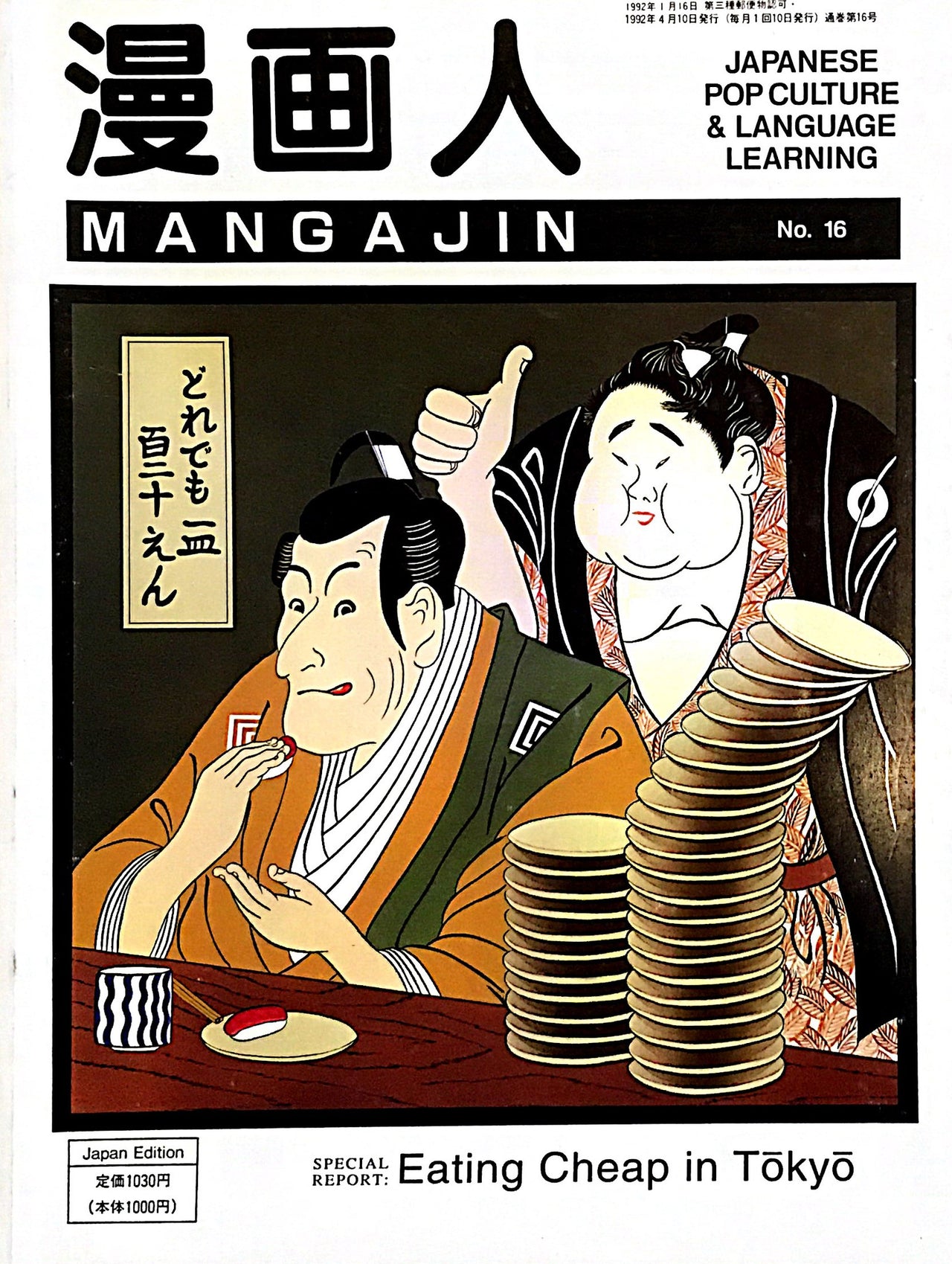
Mangajin 16
PLEASE NOTE: Mangajin ceased publication in 1998. These back issues may be new or used, but they will not be pristine. A few are still in sealed bags (for mailing), but even those are unlikely to be pristine due to shelf-wear and the amount of time passed. Please consider these as learning tools to be used rather than for collecting. That being said, if condition is important to you, please contact us with specific issues and we'll send you photos of the actual items.
Mangajin was a wonderful magazine for learners of Japanese. Each issue somehow had something for every level, but we recommend them most for upper beginners.
Those interested in translation will love how Mangajin breaks down the manga it presents, explaining grammar, vocabulary, and cultural references with ease.
The cover image above is for this particular issue. The sample pages inside may or may not be from this exact issue. See below for a table of contents (retrieved from http://www.nyx.net/~cbrown/mangajin/mangajin_toc.html)
Special Report:Eating Cheap in Tokyo
どれでも一皿百二十えん
WARNING
20
Politeness Levels - Like an extra dimension in the language
21
Pronunciation Guide (and apology from the translations)
FEATURES
6
Results from Our Reader Survey - Who in the world is actually reading this magazine? The results may surprise.
10
A Guide to Cheap Eating in Greater Tokyo - Pop culture includes food, too. In this issue, we tell you how to get around the high price of sushi.
DEPARTMENTS
5
Letters - The inside scoop on "Nori-da," plus a very special want-ad.
8
Brand News - Don't read this page if you don't appreciate a bad pun
9
Black & White Issues (II) - Frederik Schodt examines the controversy concerning racial stereotypes in Japanese manga.
14
Basic Japanese: Counters and Classifiers - You can count on Mangajin to bring you the straight scoop on counting in Japanese
75
Computer · Corner - Jim Caldwell reviews TwinBridge, a software that lets you use Japanese in English Windows applications
76
Classifieds - Computer Stuff, Job Seekers, Pen Pals, Clubs & more!
78
Mangajin · Mono - New this issue: What's Michael? Japan's favorite cat is now available in a 5-volume set
80
Vocabulary Summary - Words appearing in this issue of Mangajin
MANGA
23
The Far Side, by Gary Larson
24
O-jama Shimasu, by Imazeki Shin
30
Sarariiman Senka, by Sadao Shoji
34
Bono Bono, by Igarashi Mikio
42
Dai-Tokyo Binbo Seikatsu Manyuaru, by Maekawa Tsukasa
50
Oishinbo, by Kariya Tetsu and Hanasaki Akira
BOOKS
72
About Books - An assortment of books for the cook
73
Tokyo Rising, The City Since the Great Earthquake, by Edward Seidensticker
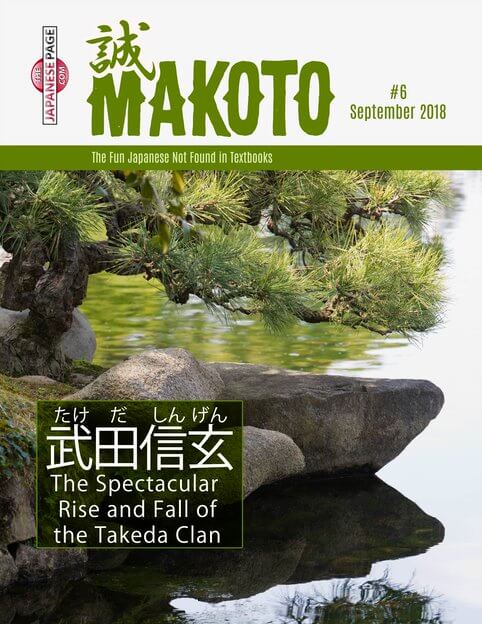
Makoto Japanese e-Zine #6 September 2018
➡️ WAIT! Want to save a dollar and get the latest issue each month? Become a member of our Makoto+ club and not only save and download new Makoto issues, but also access web-versions of the past three Makoto issues. Want more? Well, Makoto+ members also get a 10% reusable coupon good for anything at theJapanShop.com and each month, we will post a new eBook for you to download free of charge. Subscribe today for only $3 a month or $36 a year. Cancel at any time! Click here to learn more.
IN THIS ISSUE:
NEW READER: Takeda Shingen38 Pages
* Laughs, Jokes, Riddles, and Puns* Prefecture Spotlight: Kagoshima* Etymology: あばよ* Phrase of the Day: Here's looking at you, kid.* Kanji Spotlight: Behaviors* Grammar Time! しまう* Reader, Grammatical Notes, Kanji Notes, and English Translation
➡️ LEARN ABOUT BECOMING A MAKOTO+ MEMBER. CLICK HERE

Kanji de Manga Special Edition: Yojijukugo
Paperback. 112 pages. 7 x 5 inches.
-----------------
"Yojijukugo" are timeless Japanese idioms consisting of four kanji — written characters adapted from Chinese. The kanji themselves were originally drawings of images from real life. Japanese comic books and cartoons now provide fresh images to help us learn. "Kanji de Manga," recipient of the Saitama (Japan) Prefectural Government Business Innovation Special Award, uses today's manga images to make the kanji learning process fun and easy for "otaku" of all ages.
Written by Glenn Kardy, editor of several volumes in the popular How to Draw Manga series, including Getting Started, the first book of its kind to be used at major universities in the United States (UCLA) and Japan (Waseda). Artwork by Chihiro Hattori. Features a foreword by Ronald A. Morse, retired professor of Japan Studies at UCLA and the University of Nevada, Las Vegas.
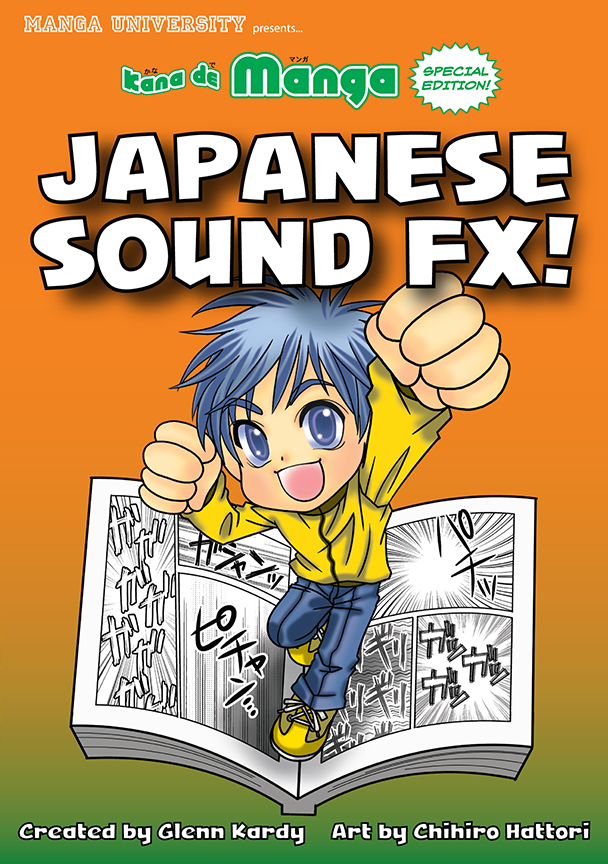
Kana de Manga Special Edition: Japanese Sound FX!
Paperback. 112 pages. 7 x 5 inches.
-----------------
Have you ever wondered what a cat's meow sounds like in Japanese? How about the grumble of an empty stomach, the vroom of an automobile or the crash of an ocean wave?
Japanese Manga artists rely heavily upon onomatopoeia — sound-effects words — and this special entry in the best-selling Kana de manga and kanji de manga language-learning series from Manga University is jam-packed with nearly 200 illustrated examples of Japanese sound effects (and their English translations) in action!
Written by Glenn Kardy, editor of several volumes in the popular How to Draw Manga series, including Getting Started, the first book of its kind to be used at major universities in the United States (UCLA) and Japan (Waseda). Artwork by Chihiro Hattori. Features a foreword by Ronald A. Morse, retired professor of Japan Studies at UCLA and the University of Nevada, Las Vegas.
![Learn Japanese through Haiku: Kobayashi Issa 小林一茶 [Paperback]](http://www.thejapanshop.com/cdn/shop/files/KobayashiIssacoversmall_03f18144-b990-4a69-a2b9-68e0b9c4ffa0_1280x.jpg?v=1732549917)
Learn Japanese through Haiku: Kobayashi Issa 小林一茶 [Paperback]
Note: This is the physical paperback version which will be shipped to your location. If you are looking for the digital only version, please click here for the bundle with this book in it. Digital products have no shipping charges!
121 pages | Paperback | Includes FREE Sound Files and eBook formats and Anki Flashcard Deck
Learn Japanese through Haiku: Kobayashi Issa
Read real Japanese today while enjoying 25 hand-picked haiku by 小林一茶 (Kobayashi Issa, 1763–1828). Issa’s poems are warm, humane, and unexpectedly funny, focusing on small creatures and everyday life. This edition gives you clear bilingual guidance, carefully curated vocabulary, and high-quality audio so you can read, listen, and truly understand.
25 Issa haiku MP3 audio included PDF + ePub + Anki Bilingual commentary Beginner to intermediate Makoto+ Explorer coming soon
What you will get
A complete read + listen learning kit
25 classic haiku presented in Japanese with natural English renderings.
Short, insightful commentary that explains grammar, word choice, and cultural cues.
Curated vocabulary lists with context so the words stick.
Professional audio: a clear poem reading plus guided commentary for each selection.
Digital bundle: printable PDF, ePub for e-readers, and an Anki deck for spaced review.
QR codes inside for instant audio access; downloadable files included with your purchase.
Coming soon: Makoto+ Japanese Explorer integration for inline furigana, audio, and fast lookups.
Listen
Sample audio from the book
Below: a poem reading and a short commentary.
Haiku reading:
Your browser does not support the audio element.
Commentary audio:
Your browser does not support the audio element.
Recorded in clear, standard Japanese. Great for shadowing and rhythm practice.
Preview
Read a page right here
Tip: Use the toolbar to zoom and navigate. If the embed does not load, open the sample PDF.
How to use it
Read. Listen. Absorb. Review.
Listen to the haiku once without reading to catch the flow and pitch.
Read the Japanese with notes, then replay the audio and shadow the lines.
Reinforce with the Anki deck and revisit a few poems during the week.
Who it is for
Haiku lovers and Japanese learners
If you love Japanese culture and want steady gains in reading, vocabulary, and listening, this book is for you. Ideal for self-learners, classrooms, and anyone who prefers meaningful, bite-size practice that fits into a busy day.
About Issa
A poet of empathy and wit
Kobayashi Issa wrote with warmth and humor about ordinary life, often giving voice to small creatures. His poems balance tenderness and irony, making them perfect gateways for learners to experience real Japanese with cultural depth.
Listen now Preview a page
![Japanese Sentence Practice for JLPT N4-Master the Japanese Language Proficiency Test N4 [Paperback]](http://www.thejapanshop.com/cdn/shop/files/JLPTN4SentenceCoverSmall_1280x.jpg?v=1700504656)
Japanese Sentence Practice for JLPT N4-Master the Japanese Language Proficiency Test N4 [Paperback]
SAVE WITH DIGITAL! This item is included in a digital bundle at a discount. If you would like the eBook version (PDF, ePub, or Kindle MOBI) and the sound files, please see our discounted bundles here - JLPT N4 BUNDLE
--
The digital files (eBook and sound files) are included with the purchase of this paperback. Simply place your order and the download link will be emailed you immediately after purchase.
Studying, tearing apart, and drilling with sentences is a great way to not only boost your reading comprehension and vocabulary but it can also help with grammar, kanji, and even pronunciation (with shadowing).
This book takes 100 sentences using JLPT N4 level vocabulary and grammar (upper beginner) and thoroughly works through them with full explanations, fill-in-the blank exercises, and translations.
201 page PDF
ePub and MOBI eBook files
100 sound files
Anki Flashcard Deck with 200 cards
UPPER BEGINNER LEVEL
Download the sound files for every Japanese example sentence within. Link emailed to you immediately after purchase.
Example sentences are broken down with a literal word-by-word translation to aid comprehension.
Each kanji has furigana (small hiragana over the kanji)
![Tobira Beginning Japanese Textbook I [BEGINNERS]](http://www.thejapanshop.com/cdn/shop/products/Coverbetter_1280x.jpg?v=1675265124)
Tobira Beginning Japanese Textbook I [BEGINNERS]
As a beginning Japanese textbook for a new generation, the concept of this book is self-discovery and connection with the world. It is packed full of language learning activities that include clear goal setting, topics appropriate to students’ knowledge level, and engagement with social media.
Suitable for self-study as well as working with a teacher.
384 pages
978-4-87424-870-6
Published by Kurosio
![Learn Japanese with Yokai! Kitsune Fox [Paperback]](http://www.thejapanshop.com/cdn/shop/products/yokai4-cover-500_1280x.jpg?v=1640797219)
Learn Japanese with Yokai! Kitsune Fox [Paperback]
Learn Japanese with Yokai! Vol. 4: The Fox and the Tanuki [PAPERBACK + DIGITAL]
For Upper Beginners to Intermediates
Preview Notice: This PDF and audio preview is from a different volume in the Learn Japanese with Yokai! series. It is included here to give you a clear idea of the format, layout, and learning approach used throughout the entire series — including this book.
🎧 Audio Preview
Normal Speed
Slow Speed (Learner-Friendly)
📘 PDF Preview
Living in shadows and the in-between world of dreams and reality, yōkai thrive in the Japanese imagination.
What exactly are yōkai? They are monsters, ghosts, unnatural beings, and even sentient household objects. Some are playful and mischievous. Others are clever, dangerous, and downright terrifying.
With this series, you don’t just read about yōkai — you learn Japanese through them.
About This Volume
Shapeshifting animals play a major role in Japanese folklore, and few are more famous — or more troublesome — than the fox and the tanuki.
In this volume, you’ll explore stories of deception, illusion, and transformation. Foxes disguise themselves as humans, conjure false rain, and manipulate reality itself. Tanuki are equally clever, often blurring the line between humor and danger.
These tales are not only engaging reading practice — they are foundational stories that appear again and again in Japanese culture, idioms, and modern media.
Length: 83 pages
Features
Three complete essays or stories focused on fox and tanuki folklore
Each story presented in three formats:1) Sentence-by-sentence breakdown with definitions and commentary2) Japanese-only version to test reading ability3) Full English translation to confirm understanding
Sentence-by-sentence sections include furigana over kanji, a complete glossary, and clear explanations of important grammar in plain English
A link to download free audio files is provided at the end of the book
Each story includes both normal-speed and slow-speed recordings read by Yumi
Stories Included
① Nine-Tailed Fox
② The Legend of the Killing Stone
③ The Fox’s Wedding
Who Is This For?
This book is designed so that both newer learners and intermediate learners can benefit.
The ideal level is upper beginner, roughly around JLPT N4. Ambitious beginners can still enjoy the material by taking it slowly, while intermediate learners will appreciate the cultural depth and grammar explanations.
If you are learning Japanese and are fascinated by yōkai, folklore, and traditional stories of old Japan, click the Buy Now button and begin studying today.
![101 Japanese Set Phrases and Power Words [Paperback]](http://www.thejapanshop.com/cdn/shop/products/set-phrases-ebook-cover-600_1280x.jpg?v=1640786350)
101 Japanese Set Phrases and Power Words [Paperback]
SAVE WITH DIGITAL! This item is included in a digital bundle at a discount. If you would like the eBook version (PDF, ePub, or Kindle MOBI) and the MP3s, please see our discounted bundles here - Beri- Beri- Shoshinsha
129 page paperback
Printable PDF
Over 100 sound files with each phrase and example sentence
Works on both PCs and Macs
NOW FREE Kindle and Nook ebook versions
ePub works on Android devices with FBReader and possibly other EPUB book reader apps.
Give your Japanese a boost by learning 101 Japanese Set Phrases and Power Words!
Every language has phrases and expressions that are used on an everyday basis. Every single entry in the book is a phrase or a form of a phrase that is used daily in Japanese.
Learning these power words and phrases will greatly improve your conversational skills.
* Every entry has at least one example sentence
* Usage and variations are explained in plain English
* Listen to the sound files for pronunciation help