
• 100% ringspun cotton
• 4.5 oz (153 g/m2)
• Pre-shrunk
• Shoulder-to-shoulder taping
• Quarter-turned to avoid crease down the center
Model is wearing a size M. He's 6.2 feet (190 cm) tall, chest circumference 37.7" (96 cm), waist circumference 33.4" (85 cm).
The graphic of the word "勇" does not belong to Japan,It has nothing to do with Japanese culture, this is the style of the Qing Dynasty
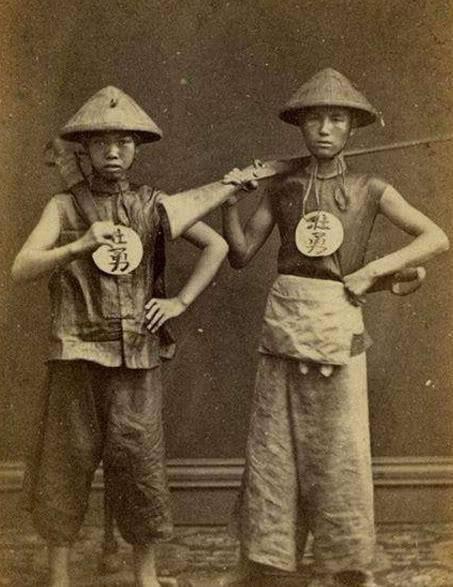
勇 means 'courage' in both Japanese and Chinese. Kanji were imported from China into Japan over many centuries, and in many cases, Japanese and Chinese share the same character both in meaning and appearance. You can see how 勇 is used across various languages here:
https://en.wiktionary.org/wiki/%E5%8B%87
But to say 'it doesn’t belong to Japan' is like saying 科学 (or 科學 in traditional Chinese, meaning 'science') doesn’t belong to Chinese—just because it was originally a 和製漢語 (わせいかんご), or 'Japanese-made Sino-compound.' In other words, 科学 is widely used in Chinese today, but it was coined by the Japanese during the Meiji period. The Japanese imported Chinese characters, created a new compound word, and later that word was reimported into Chinese. This pattern holds true for many scientific and philosophical terms that were born in Japan and then adopted by other East Asian languages.
Languages constantly evolve and borrow from one another. Take カタカナ英語 (English loanwords written in katakana), for example. Just because テレビ originally came from 'television' doesn’t mean テレビ isn’t a real Japanese word. :)
- 5 stars: 0 (0%)
- 4 stars: 0 (0%)
- 3 stars: 1 (100%)
- 2 stars: 0 (0%)
- 1 star: 0 (0%)
The graphic of the word "勇" does not belong to Japan,It has nothing to do with Japanese culture, this is the style of the Qing Dynasty
勇 means 'courage' in both Japanese and Chinese. Kanji were imported from China into Japan over many centuries, and in many cases, Japanese and Chinese share the same character both in meaning and appearance. You can see how 勇 is used across various languages here:
https://en.wiktionary.org/wiki/%E5%8B%87
But to say 'it doesn’t belong to Japan' is like saying 科学 (or 科學 in traditional Chinese, meaning 'science') doesn’t belong to Chinese—just because it was originally a 和製漢語 (わせいかんご), or 'Japanese-made Sino-compound.' In other words, 科学 is widely used in Chinese today, but it was coined by the Japanese during the Meiji period. The Japanese imported Chinese characters, created a new compound word, and later that word was reimported into Chinese. This pattern holds true for many scientific and philosophical terms that were born in Japan and then adopted by other East Asian languages.
Languages constantly evolve and borrow from one another. Take カタカナ英語 (English loanwords written in katakana), for example. Just because テレビ originally came from 'television' doesn’t mean テレビ isn’t a real Japanese word. :)
The Japan Shop has made books for learners of Japanese since 2002: eBooks and paperbacks with native-speaker audio and every word explained, plus the free Makoto+ app to read them in. More than 200,000 books sold.
» Download the latest Makoto e-zine issue, read three months of web-based Makoto issues, get exclusive TheJapanShop.com coupons, freebie downloads, and much more, starting at only $5 a month!
Learn more here - Be an affiliate
© 2026 The Japan Shop Powered by Shopify. | Kotoba, Inc. | Please read our Privacy Policy for Personal information and cookies we collected. | Contact information